
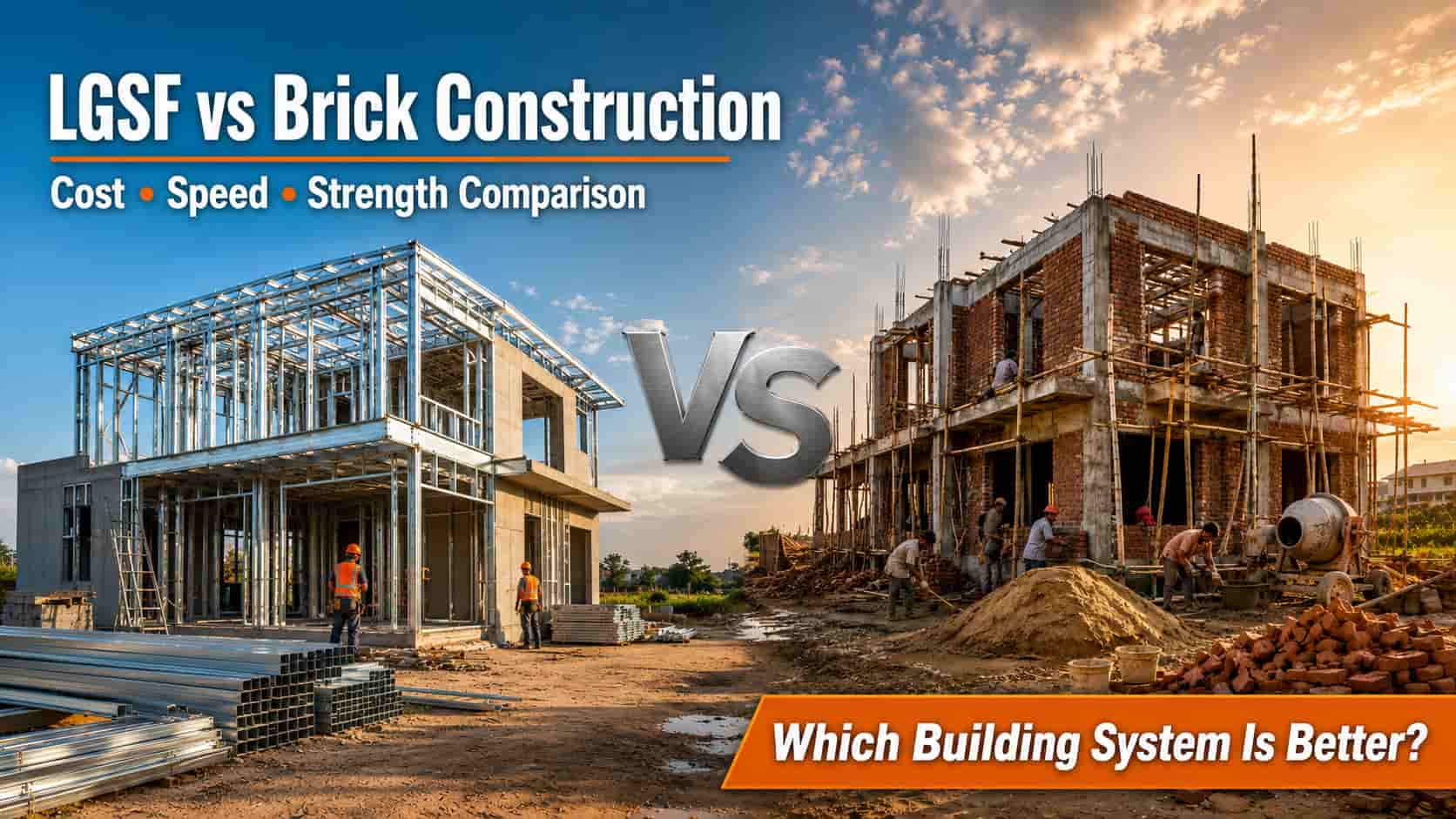
LGSF vs Brick Construction: Cost, Speed & Strength Comparison in India
If you are planning to build a home or commercial building in India, you have probably heard about LGSF (Light Gauge Steel Frame) construction and wondered how it compares with the traditional brick-and-RCC method your contractor knows. Both technologies can deliver a strong, beautiful, permanent building, but they differ enormously in speed, weight, quality control, and long-term value. This detailed comparison breaks down LGSF vs brick construction across every parameter that matters, so you can make an informed decision.
Understanding the Two Systems
Conventional Brick and RCC Construction
In the traditional method, an RCC frame (columns, beams, slabs) carries the load, and brick or block masonry fills the walls. Construction is labour-intensive, wet (requiring large quantities of water, sand, and cement), and sequential: you cannot plaster before masonry sets, and you cannot proceed before concrete cures.
LGSF Construction
In LGSF, the structure is a skeleton of cold-formed galvanized steel studs and tracks, engineered by software and manufactured by CNC roll-forming machines. Walls are completed with fibre cement or gypsum boards and cavity insulation. Construction is dry, fast, and factory-precise.
Speed of Construction: LGSF Wins Decisively
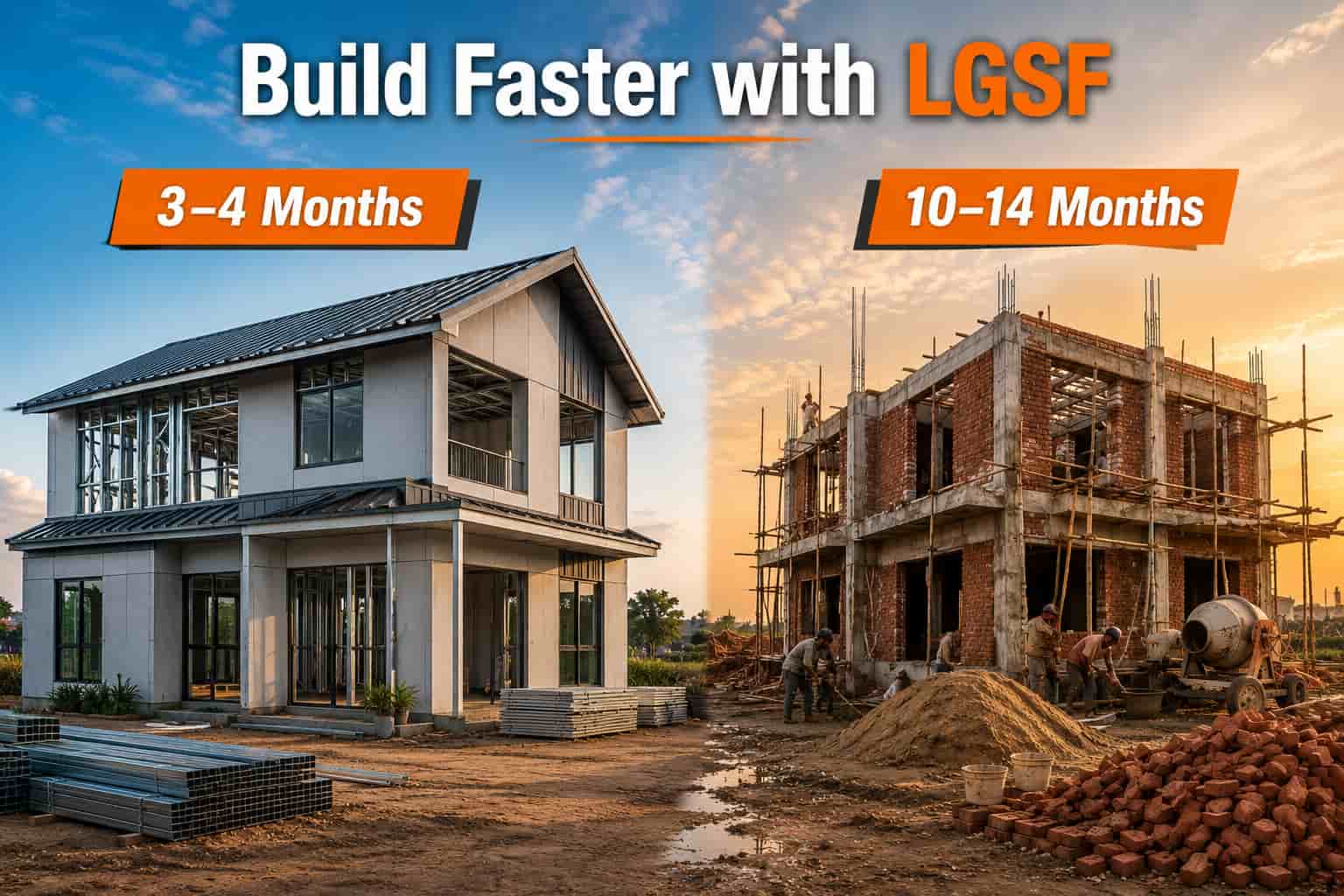
This is where the difference is most dramatic. A conventional G+1 house of around 2,000 sq ft typically takes 10 to 14 months, including curing periods, monsoon interruptions, and labour delays. The same house in LGSF is delivered in 3 to 4 months, because panels are manufactured while the foundation is being cast, erection takes days rather than months, there is zero curing time, and interior work starts almost immediately.
For commercial builders, this speed converts directly into money: earlier rental income, earlier possession, lower interest paid on construction finance, and lower site overheads. A project finished six months earlier can offset a significant portion of the structure cost through savings alone.
Cost Comparison: The Honest Answer
Direct Construction Cost
On pure superstructure cost per square foot, LGSF is typically comparable to or 5 to 15 percent higher than good-quality conventional construction, depending on specification. A fair 2026 range for complete LGSF construction in Eastern India is approximately Rs 1,800 to Rs 2,500 per sq ft for standard residential specifications, versus Rs 1,700 to Rs 2,200 for equivalent conventional quality.
Hidden Savings That Change the Equation
The direct comparison misses several major LGSF savings. Foundation cost drops 20 to 40 percent because the structure weighs up to 60 percent less. Construction-period costs shrink: fewer months of site supervision, watchmen, scaffolding rental, and finance interest. Wastage is under 2 percent in LGSF versus 10 to 15 percent in conventional construction, where sand, cement, and bricks routinely disappear or get spoiled. Carpet area increases because a finished LGSF wall is around 100 to 150 mm thick versus 230 mm plus plaster for brick, adding 4 to 6 percent usable area on the same plot. When you total lifetime and project-level cost, LGSF is frequently equal to or cheaper than conventional construction, while delivering months earlier.
Strength and Structural Safety
Load-Bearing Capacity
Both systems, properly designed, meet Indian structural codes. LGSF buildings are engineered member-by-member in software, with every stud and screw calculated, whereas conventional construction quality depends on how honestly the mix was batched and how well the bars were tied on a given day.
Earthquake Performance
This is a clear LGSF advantage. Seismic force is proportional to building weight, and an LGSF building weighs roughly half. Steel is ductile: it bends and absorbs energy rather than cracking. Screwed connections allow micro-movement without failure. In seismic zones IV and V (Northeast India, parts of Bihar and North Bengal), LGSF is arguably the safest mainstream residential technology available.
Cyclone and Wind Performance
LGSF structures are designed with continuous load paths and hold-down anchors from roof to foundation, which is exactly the detailing that cyclonic regions need. Conventional roofs, especially tiled or sheeted ones on brick gables, are far more vulnerable.
Durability, Maintenance and Lifespan
A common myth is that steel buildings rust away. Modern LGSF uses galvanized steel (zinc coatings from Z120 to Z275 GSM) that is protected inside a dry, sealed wall cavity, away from weather. International experience and accelerated testing show design lifespans of 50 to 100 years. Brick buildings last long too, but suffer plaster cracks, dampness, seepage-driven corrosion of RCC reinforcement, and termite attack on woodwork. LGSF is termite-immune, does not crack like plaster, and its boards can be individually replaced if ever damaged.
Comfort, Insulation and Energy Bills
A 230 mm brick wall has surprisingly poor insulation. An LGSF cavity wall filled with glass wool or rockwool typically achieves two to three times better thermal resistance, keeping interiors cooler in summer and warmer in winter, and cutting air-conditioning energy use by 20 to 30 percent. Acoustic insulation is also superior when designed with the right board and insulation combination.
Design Flexibility and Future Modification
Want to add a room, shift a partition, or extend vertically after five years? In LGSF, partitions are non-wet and demountable, and the light weight makes vertical extension on existing buildings feasible where brick would overload the structure. Conventional modification means demolition, debris, dust, and weeks of disruption.
Where Brick Still Makes Sense
To be fair: conventional construction remains sensible when local LGSF expertise is unavailable, for very small budget-driven projects where the cheapest local labour rate wins, or where the owner strongly prefers the familiar. The gap, however, narrows every year as steel supply chains mature.
Verdict: Which Should You Choose?
Choose LGSF if you value speed, seismic safety, precision quality, better insulation, and predictable cost. Choose conventional only if LGSF expertise is genuinely unavailable in your region. For projects in West Bengal and Northeast India, Jadro Steel LLP manufactures and erects complete LGSF building systems from Howrah, with in-house design, roll-forming, and erection teams, giving you single-point responsibility from drawing to handover.
FAQ
Q1. Is LGSF cheaper than brick construction?
On superstructure alone, LGSF is comparable or slightly higher. But after adding foundation savings, extra carpet area, lower wastage, and 6+ months of time savings, total project cost is often equal or lower.
Q2. Which is stronger, LGSF or brick?
Both meet code when properly built, but LGSF performs significantly better in earthquakes and cyclones due to its light weight, ductility, and engineered connections.
Q3. Can banks give home loans for LGSF houses?
Yes. LGSF is a recognised permanent construction technology, and housing finance is available just as for conventional homes.
Q4. Do LGSF walls sound hollow?
Properly built LGSF walls with double boards and cavity insulation feel solid and actually provide better sound insulation than a single brick wall.
Q5. Can I hang a TV, geyser, or cabinets on LGSF walls?
Yes. Fixtures anchor directly into steel studs, which hold far more load than plugs in brick. Heavy items are simply aligned with stud positions or backing plates.
Q6. What is the resale value of an LGSF house?
Resale depends mainly on location and finish quality. As LGSF awareness grows in India, well-built steel-framed homes are valued at par with conventional homes.